
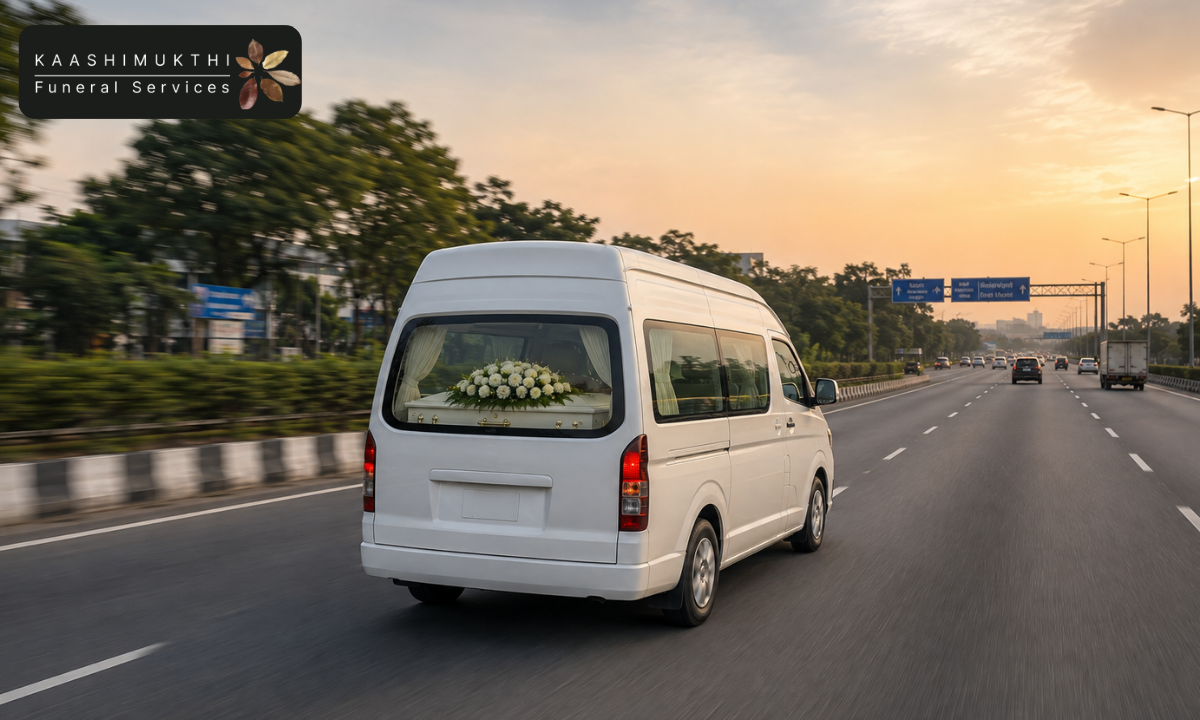
When someone passes away in Delhi but the family wants to take them back to their hometown in another state, Dead Body Transportation in Delhi may need to be arranged quickly, along with several other important formalities.
The family may be dealing with hospital formalities, death certificates, transportation, police documentation in certain cases, and cremation arrangements at the destination. At the same time, relatives may be travelling from different cities and trying to make decisions over the phone.
Interstate dead body transportation from Delhi is the process of safely transporting the deceased from Delhi to another state, usually by a suitable hearse or mortuary vehicle.
The process is different from ordinary local transportation because the journey may take several hours or even a full day. The right vehicle, preservation arrangements and documentation therefore become especially important.
This guide explains what families should know before arranging interstate transportation from Delhi.
When Is Interstate Dead Body Transportation Needed?
Interstate transportation may be required when a person dies in Delhi but the family wants the funeral to take place in their hometown or ancestral place.
For example:
- A person from Uttar Pradesh dies while working in Delhi.
- A patient from Bihar passes away during treatment in Delhi.
- A family living in Haryana wants to take their relative back home.
- Someone from Rajasthan dies while visiting Delhi.
- An elderly parent from Punjab passes away while staying with their children in Delhi.
In each situation, the family may want the deceased transported from Delhi to another state.
The destination could be a family home, mortuary, cremation ground or another location where the final rites will be performed.
Which States Can the Deceased Be Transported To?
Interstate transportation can potentially be arranged from Delhi to many parts of India, depending on the circumstances, road conditions, vehicle availability and documentation.
Common destinations from Delhi include:
- Uttar Pradesh
- Haryana
- Rajasthan
- Punjab
- Uttarakhand
- Himachal Pradesh
- Bihar
- Madhya Pradesh
- Jharkhand
- West Bengal
The important thing is to provide the exact destination, not just the state.
For example, saying:
“We need to go to Uttar Pradesh”
isn’t enough for a transportation quotation.
The service provider will generally need to know whether the destination is Lucknow, Agra, Varanasi, Kanpur, Gorakhpur, Prayagraj or a smaller town or village.
Distance can make a significant difference to the transportation arrangement.
How Does Interstate Dead Body Transportation From Delhi Work?
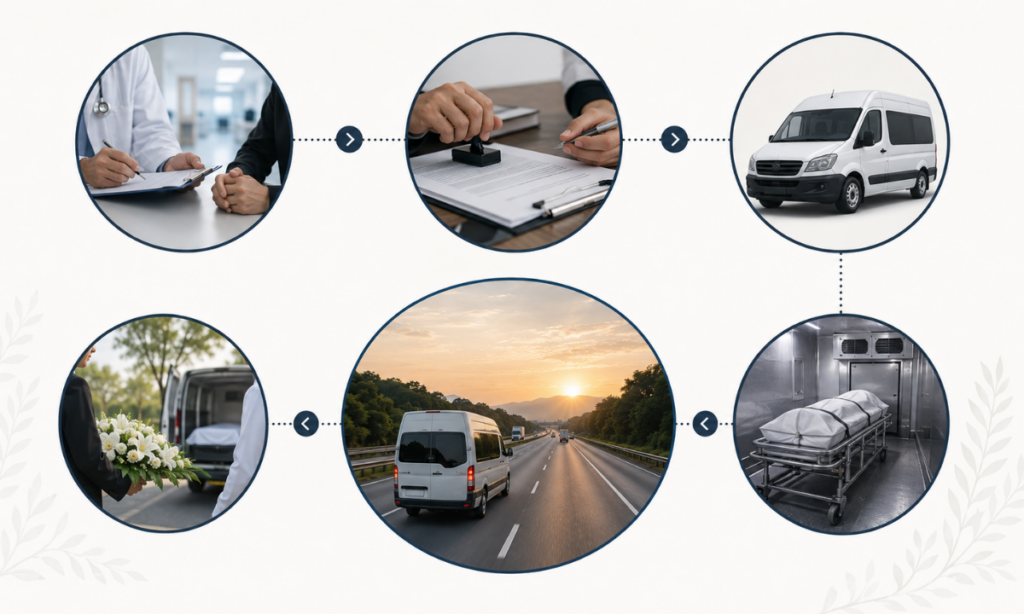
The process is easier when handled in a logical order.
A typical arrangement looks like this:
Confirm the death → Complete hospital/home formalities → Arrange documentation → Select the vehicle → Confirm destination → Arrange preservation if required → Start transportation → Complete destination-side arrangements
Let’s look at each part.
Step 1: Complete the Formalities at the Place of Death
Before arranging long-distance transportation, establish where the deceased is currently located.
It could be:
- A hospital
- Home
- Mortuary
- Nursing facility
- Another medical facility
If the death occurred in a hospital, the family generally needs to complete the hospital’s release formalities and obtain the relevant documentation.
If the death occurred at home, appropriate medical certification may be required.
If the death was accidental, unnatural or under investigation, additional procedures may apply.
Don’t start interstate transportation until the deceased has been legally released for transport.
Step 2: Keep the Required Documents Ready
Documentation is particularly important when transporting a deceased person over a long distance.
The exact documents depend on the circumstances, but families may need relevant documents such as:
- Death certificate or medical death documentation
- Medical certificate of cause of death
- Hospital discharge/release documentation
- Identification of the deceased
- Identification of the family member coordinating the transport
- Post-mortem documents, where applicable
- Police documentation or clearance, where applicable
The documentation requirements can differ between a natural hospital death, a death at home and an accidental or unnatural death.
So don’t assume that the same checklist applies to every case.
If you’re unsure, ask the hospital, relevant authority or funeral service provider what is required before the vehicle leaves Delhi.
Step 3: Choose the Right Vehicle
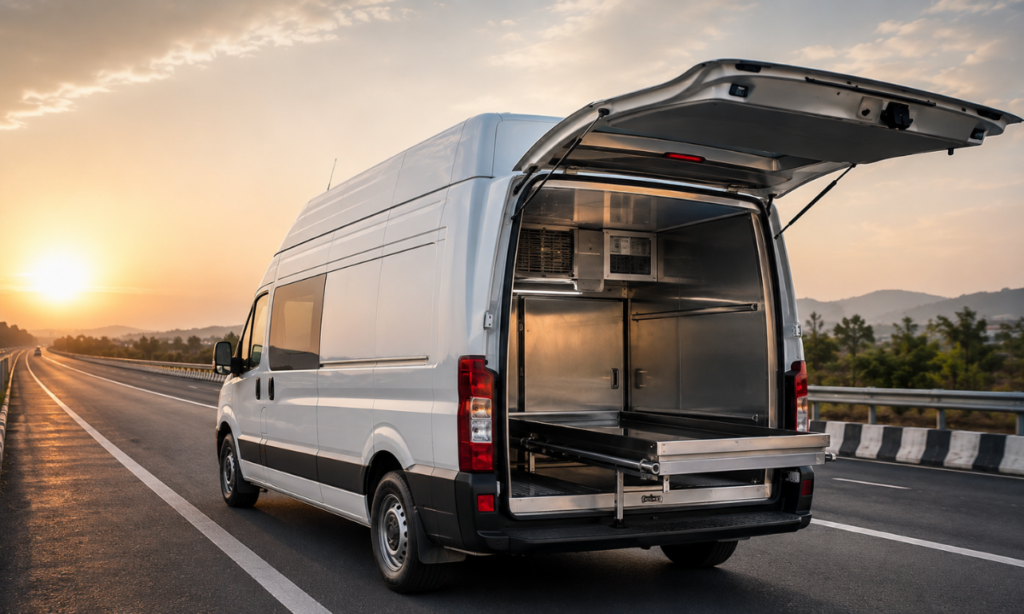
Long-distance transportation requires a vehicle appropriate for transporting the deceased.
Depending on the situation, families may consider:
- Hearse van
- Mortuary vehicle
- Freezer-equipped vehicle
- AC funeral vehicle
- Other suitable long-distance funeral transportation
For a short Delhi-NCR journey, the requirements may be relatively simple.
For a journey from Delhi to Bihar, Rajasthan, Uttar Pradesh or another distant state, preservation and temperature control may become much more important.
The vehicle should be selected according to:
Distance + weather + expected journey time + condition of the deceased + family requirements
A vehicle that is suitable for a two-hour journey may not be the best choice for a 15-hour road journey.
Why a Freezer-Equipped Vehicle May Be Important
Long-distance transportation is not the same as travelling across Delhi.
The journey can take many hours, and traffic, road conditions and stops can make the trip longer than expected.
A freezer-equipped mortuary vehicle can help maintain an appropriate environment during transportation.
It may be especially relevant when:
- The destination is far from Delhi
- The journey will take many hours
- The cremation will occur later
- Relatives need time to gather
- There is a delay in reaching the destination
The exact preservation method should be decided based on the circumstances and applicable professional guidance.
Step 4: Provide the Exact Pickup and Destination
When requesting interstate transportation, provide complete details.
Pickup
For example:
AIIMS Delhi
or
A residence in South Delhi
or
A mortuary in Central Delhi
Destination
For example:
Lucknow, Uttar Pradesh
or
Gaya, Bihar
or
Jaipur, Rajasthan
For a village destination, provide:
- Village name
- District
- State
- Nearest town
- Landmark, if necessary
This helps the provider calculate the journey and arrange the appropriate vehicle.
Step 5: Ask About the Total Transportation Cost
Interstate transportation doesn’t have one fixed price.
The cost can depend on:
- Total distance
- Vehicle type
- Freezer facility
- Pickup location
- Destination
- Travel time
- Waiting time
- Return journey
- Road tolls or other applicable expenses
- Additional preservation requirements
This is why a provider should ideally give a quotation based on the actual pickup and destination.
For example, Delhi to Agra and Delhi to Patna should not be expected to have the same transportation cost.
A useful question to ask
Instead of asking:
“How much does dead body transportation cost?”
say:
“The deceased is currently at [location] in Delhi and needs to be transported to [exact destination]. What vehicle do you recommend and what is the complete cost?”
That gives the provider the information needed to calculate the requirement.
Can a Dead Body Be Transported by Road From Delhi to Another State?
Yes, road transportation is one of the common options for interstate movement within India.
A suitable hearse or mortuary vehicle can be used depending on the journey.
Road transportation can be practical when the destination is within a manageable driving distance.
For example:
Delhi → Haryana
Delhi → Uttar Pradesh
Delhi → Rajasthan
Delhi → Punjab
may be handled by road depending on the exact destination.
For very long distances, families may also consider air transportation, particularly when time is an important consideration.
Delhi to Uttar Pradesh
Uttar Pradesh is one of the major destinations for people travelling from Delhi.
Families may need transportation to cities such as:
- Lucknow
- Agra
- Kanpur
- Varanasi
- Meerut
- Prayagraj
- Gorakhpur
- Bareilly
The exact vehicle and cost depend heavily on the final destination.
For a village, the family should provide the district and nearest town, not just the village name.
Delhi to Haryana
Haryana is relatively close to Delhi, but the journey can still vary significantly depending on the destination.
Possible destinations include:
- Gurugram
- Faridabad
- Rohtak
- Panipat
- Hisar
- Karnal
- Ambala
For nearby destinations, a standard hearse may be sufficient depending on the circumstances.
For longer journeys, the family may need a vehicle with appropriate preservation arrangements.
Delhi to Rajasthan
Families may need transportation from Delhi to:
- Jaipur
- Alwar
- Bharatpur
- Ajmer
- Kota
- Bikaner
- Jodhpur
The distance makes vehicle selection particularly important.
Ask how long the provider expects the journey to take and whether a freezer-equipped vehicle is recommended.
Delhi to Punjab
Transportation can also be arranged to destinations such as:
- Ludhiana
- Amritsar
- Jalandhar
- Patiala
- Bathinda
- Chandigarh region
The family should give the exact destination before receiving a quotation.
Delhi to Bihar
For longer journeys such as Delhi to Bihar, the family should pay particular attention to preservation and travel time.
Possible destinations include:
- Patna
- Gaya
- Muzaffarpur
- Bhagalpur
- Darbhanga
- Purnia
A long road journey requires more planning than a local Delhi transfer.
What If the Death Occurred After a Post-Mortem?
If the deceased underwent a post-mortem, the family may need additional documentation before transportation.
The body may be released only after the relevant medical and legal procedures have been completed.
The family should confirm:
- Post-mortem completed
- Body released
- Required police documentation completed
- Medical documentation available
- Transportation can legally begin
A funeral service provider can coordinate transportation after the necessary release procedures are completed, but cannot bypass an official hold.
What If the Death Was Accidental?
An accidental or unnatural death can involve police procedures and investigation.
This means the normal transportation process may not apply immediately.
The family should first confirm that the authorities have released the deceased for transportation.
Once the required clearance is available, the family can proceed with the interstate arrangements.
This is one situation where trying to move too quickly can actually create additional problems.
What If the Family Wants to Take the Deceased Home First?
Sometimes the family doesn’t want to take the deceased directly to the crematorium.
They may want to bring the deceased home so relatives can pay their respects before the final rites.
In that case, the route might be:
Delhi hospital → family home → hometown → crematorium
rather than:
Delhi hospital → hometown crematorium
This should be discussed before transportation begins because it can affect:
- Travel time
- Preservation requirements
- Vehicle waiting
- Total cost
- Final cremation timing
What If Relatives Are Coming From Other Cities?
This is common when a person who worked in Delhi passes away.
Family members may be travelling from:
- Mumbai
- Bengaluru
- Chennai
- Hyderabad
- Kolkata
- Pune
- Another country
The family may therefore need to coordinate the vehicle arrival with the relatives’ travel plans.
If the body reaches the hometown before the relatives, additional arrangements may be needed.
It’s better to discuss the expected arrival time with the funeral service provider beforehand.
Can the Deceased Be Transported by Air From Delhi?
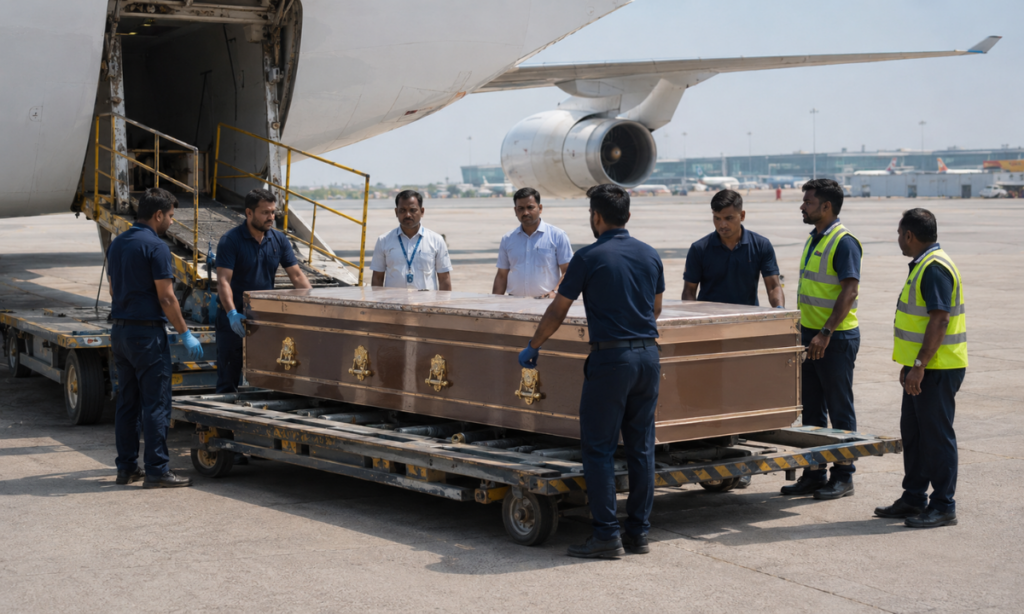
For very long distances, air transportation may be considered.
This is a separate process from road transportation and can involve:
- Airline requirements
- Embalming where required
- Coffin requirements
- Documentation
- Airport cargo procedures
- Booking
- Destination-side collection
- Coordination with the receiving family
If the destination is very far away, compare road vs air transportation based on distance, urgency, cost and the family’s circumstances.
Don’t assume air travel is automatically faster or easier—the documentation and airport coordination can add their own requirements.
What Happens When the Body Reaches the Hometown?
The destination-side arrangement should be planned before the vehicle leaves Delhi.
Someone should know:
- Expected arrival time
- Exact destination
- Driver contact
- Where the vehicle should go
- Who will receive the deceased
- Where the final rites will take place
The final destination may be:
- Family residence
- Local mortuary
- Crematorium
- Burial ground
This is especially important when the destination is a rural area.
What If the Family Needs a Freezer Box?
If the deceased will remain at home before the final rites, the family may need a freezer box.
This can be particularly useful when:
- Relatives need time to arrive
- The cremation is scheduled for the following day
- The journey has been delayed
- The body is being transported over a long distance
If the deceased is being transported in a freezer-equipped vehicle, ask whether the vehicle provides continuous preservation throughout the journey.
How Long Does Interstate Transportation Take?
There is no single answer.
Travel time depends on:
- Distance
- Traffic leaving Delhi
- Highway conditions
- Weather
- Road restrictions
- Destination location
- Stops during the journey
- Vehicle speed and safety considerations
A trip to a nearby Haryana or Uttar Pradesh destination may take only a few hours.
A trip to Bihar, Rajasthan or another distant state can take considerably longer.
A funeral service provider should give you an estimated travel time, not a guaranteed arrival time.
How Kaashimukthi Can Help
Kaashimukthi can help families coordinate interstate transportation from Delhi based on the pickup location, destination and circumstances.
Depending on the family’s requirements, assistance may include:
- Hearse or mortuary vehicle
- Freezer-equipped transportation
- Hospital pickup
- Home pickup
- Documentation guidance
- Long-distance transportation
- Destination coordination
- Crematorium coordination
- Priest and last-rites arrangements
The appropriate vehicle and service depend on the journey.
For example, a short Delhi-to-Haryana journey may require a different arrangement from Delhi-to-Bihar transportation.
What Information Should You Give When Booking?
When contacting Kaashimukthi, keep these details ready:
Pickup
- Exact location in Delhi
- Hospital/home/mortuary
- Hospital name, if applicable
Deceased
- Name
- Date of death
- Circumstances of death
- Whether post-mortem was performed
Destination
- State
- City/town
- District
- Village, if applicable
- Final cremation/burial location
Transportation
- Preferred date
- Preferred departure time
- Whether freezer-equipped transportation is required
- Whether the deceased needs to stop at the family home
The more accurate the information, the easier it is to arrange the right vehicle.
Interstate Dead Body Transportation Checklist
Before the vehicle leaves Delhi, confirm:
Documents
- Death-related documents ready
- Hospital release completed
- Identification available
- Post-mortem documents, if applicable
- Police clearance, if applicable
Vehicle
- Appropriate hearse/mortuary vehicle confirmed
- Freezer facility confirmed if required
- Driver details received
- Pickup time confirmed
Destination
- Exact address provided
- District and state confirmed
- Destination contact available
- Crematorium/burial arrangements discussed
Family
- Relatives informed
- Expected arrival time shared
- Person receiving the deceased identified
- Final rites planned
Common Mistakes Families Make
Choosing a vehicle based only on price
The cheapest vehicle isn’t necessarily appropriate for a long-distance journey.
Not giving the exact destination
“Bihar” isn’t enough.
Give the city, district and village where necessary.
Forgetting about preservation
Long journeys may require additional arrangements.
Waiting until the last minute
Documentation and vehicle availability can take time.
Not planning the destination
The vehicle shouldn’t arrive at the hometown with nobody ready to receive the deceased.
Assuming every death follows the same process
Hospital, home, accidental and post-mortem cases can have different requirements.
Final Thoughts
Taking a loved one from Delhi back to their hometown is emotionally difficult, and the practical arrangements can feel complicated.
The process becomes easier when it is broken into a few clear steps:
Complete the formalities → Prepare documents → Confirm the destination → Choose the appropriate vehicle → Arrange preservation if needed → Plan the journey → Coordinate the destination → Complete the final rites.
Whether the destination is Uttar Pradesh, Haryana, Rajasthan, Punjab, Bihar, Uttarakhand or another state, the exact requirements depend on the circumstances and distance.
If you need interstate dead body transportation from Delhi, Kaashimukthi can help coordinate the journey based on the pickup location, destination and family’s requirements.
When requesting a quotation, provide the exact pickup location in Delhi and the complete destination address. This allows the transportation team to recommend the appropriate vehicle and explain the expected cost clearly.
Note: Documentation and transportation requirements can vary depending on the circumstances of death, destination state and mode of transport. Confirm the applicable requirements with the hospital, relevant authorities and transportation provider before beginning an interstate journey.

Madhu is an Entrepreneur, a Mentor, a Writer and an Aspiring Car Race Driver. He is Deeply passionate about leveraging Technology and Human Centred Design to make complex care and End of Life Planning easier. With the ultimate aim of Improving the quality of Life in the Twilight years. Madhu is highly educated and Alumni of IIM-Bangalore, Sikkim Manipal University and Bangalore University besides a Rich Industry Experience in the field of Product Management, Design, Supply chain, Finance, Commercial Management and Funeral Services.