
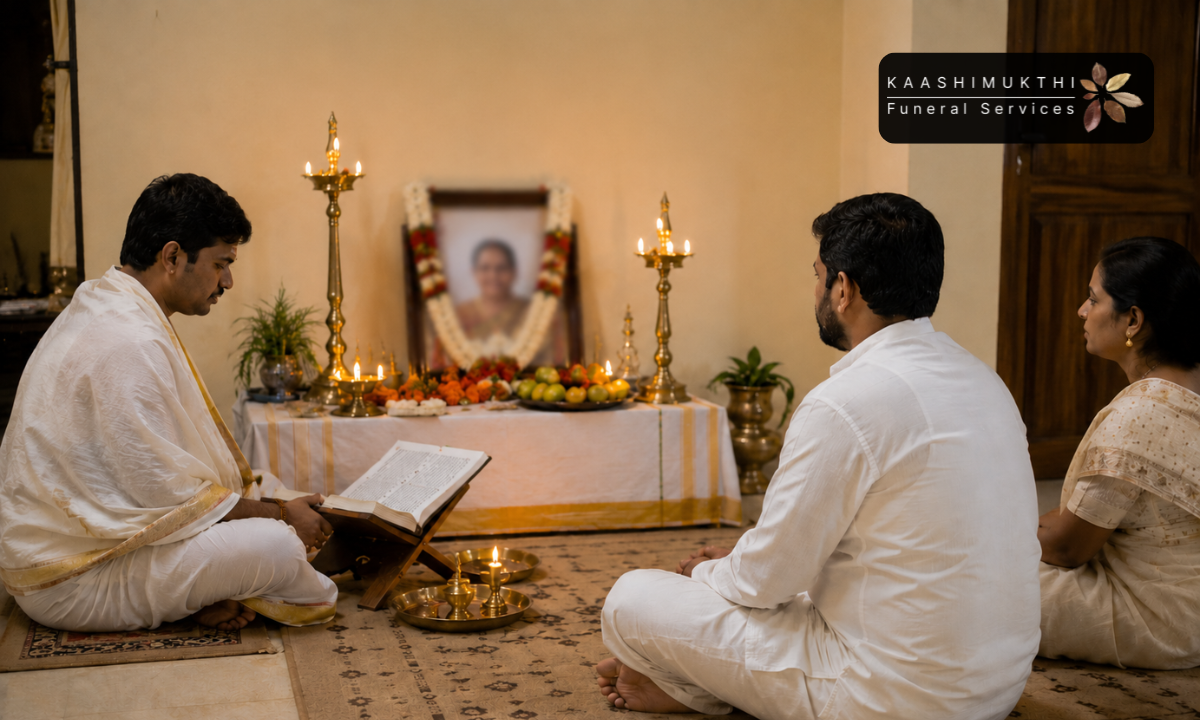
The loss of a loved one brings an unparalleled stillness to a home, leaving families to navigate a profound space between deep grief and sacred duty. In the Sanatana Dharma tradition, the passing of the physical body is not viewed as an absolute end, but rather as the beginning of the soul’s pivotal journey toward the divine.
Ensuring this transition is peaceful requires meticulous adherence to ancient rites. However, managing these arrangements during a time of mourning can be overwhelming. Whether you are seeking a knowledgeable Pandit for funerals, arranging dignified cremation services in Bangalore, the right guidance is essential to honour the departed soul correctly.
Amidst the deeply revered customs that follow a passing, the recitation of the Garuda Purana holds a remarkably unique and sacred position. While the immediate rites focus on the physical elements of parting, the days that follow are dedicated entirely to the spiritual voyage of the Atman (soul).
Our ancient sages understood that both the departed soul and the grieving family require direction. The recitation of sacred texts during the mourning period acts as a bridge of comfort, ensuring the living find peace while the departed find their way to liberation.
In this guide, we will explore the profound spiritual and psychological importance of this ancient scripture, uncovering how its divine verses act as a guiding light for your loved one’s final, sacred journey.
What is the Garuda Purana? A Divine Dialogue
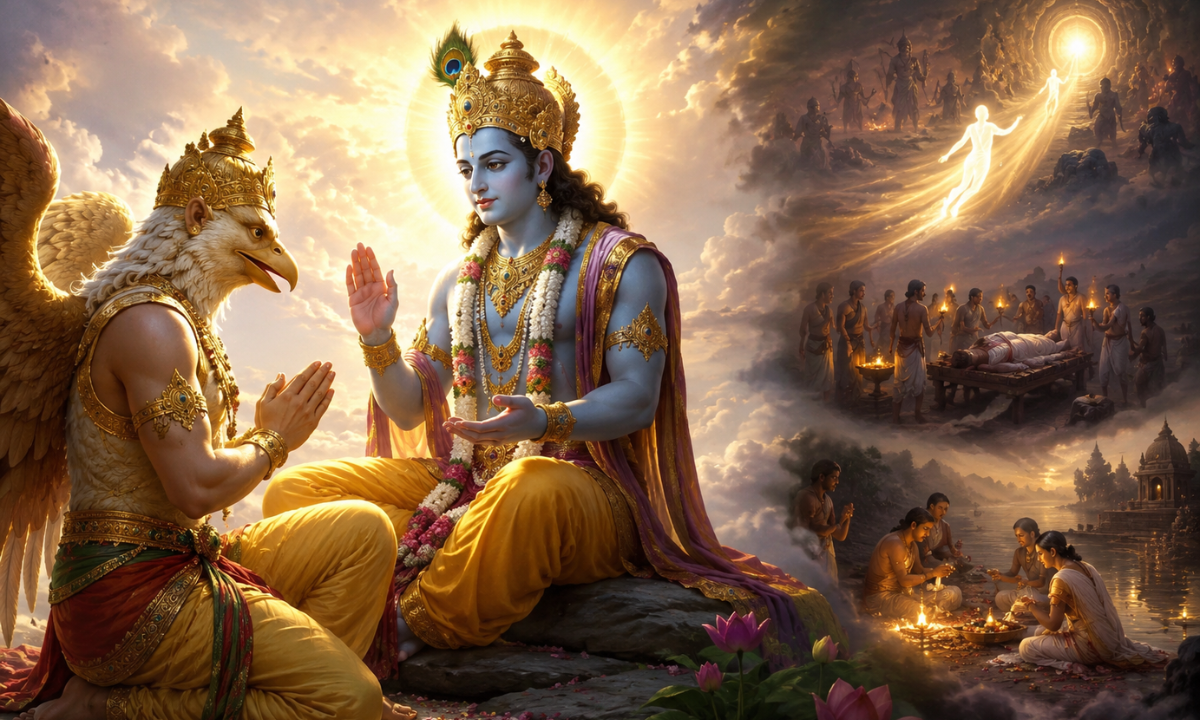
To truly understand the comfort this scripture brings, one must first understand its origins. Among the eighteen Mahapuranas (great ancient texts) of Sanatana Dharma, the Garuda Purana holds a highly specialised and deeply revered place.
Rather than a mere collection of rules, it is presented as a profound, intimate conversation between the Supreme Lord of Preservation, Sri Maha Vishnu, and His devoted mount, the eagle-king Garuda.
According to the scripture, Garuda, moved by deep compassion and witnessing the sorrow that humanity experiences upon the passing of a loved one, asks Lord Vishnu to demystify the mysteries of death. He asks the questions that weigh heavily on every grieving heart: Where does the soul go? What happens after the physical body is left behind? How can the living help their departed cross over peacefully?
It is a common misconception that the Garuda Purana is meant to instil fear of the afterlife. In truth, Lord Vishnu’s answers are born of immense divine love. He reveals the journey of the soul so that the living can actively assist their ancestors in finding peace and ultimate liberation (Moksha).
The Pretakhanda and The Manual for the Soul’s Journey
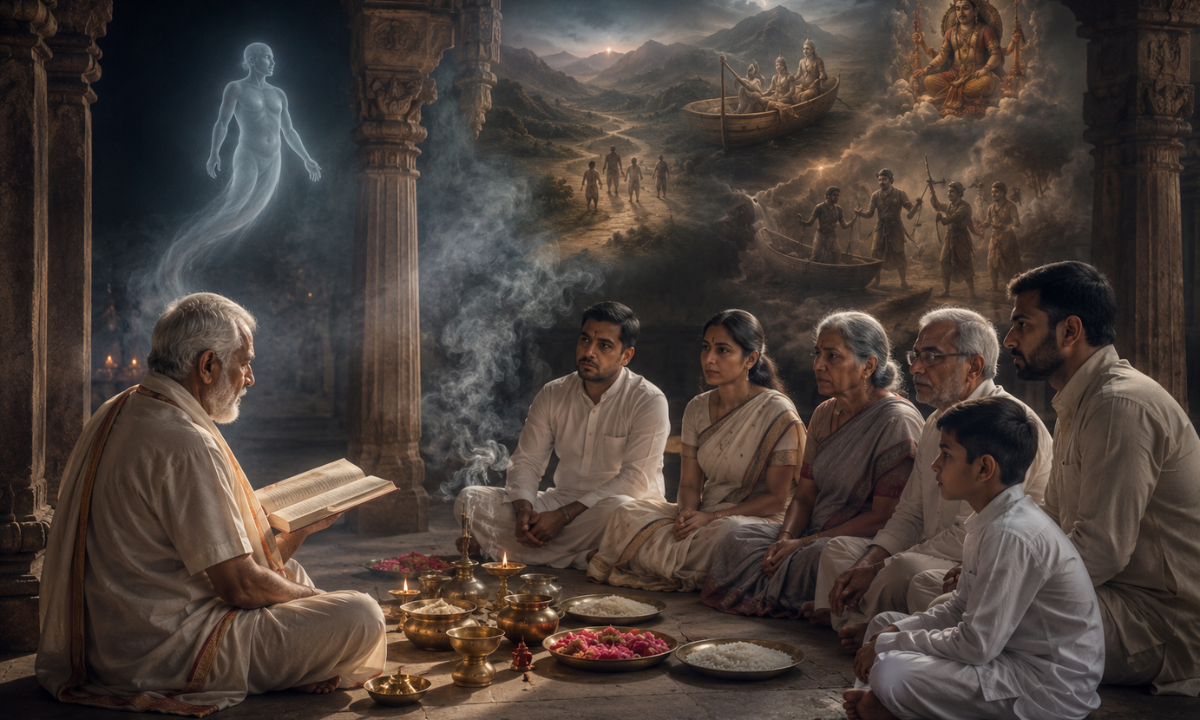
The Garuda Purana is vast, covering many aspects of life, astronomy, and medicine. However, the specific section recited during the mourning period is the Pretakhanda (also known as the Sarroddhara). This section acts as a meticulous spiritual roadmap, detailing:
- The Sookshma Shareera (The Subtle Body): It explains how the soul sheds the physical body but retains a subtle, invisible form that lingers near the family immediately after passing.
- The Weight of Karma: It gently clarifies how earthly actions shape the soul’s path, emphasising that sincere prayers from the family can help alleviate the soul’s karmic burdens.
- The Geography of the Afterlife: It provides a vivid description of the path the soul must travel to reach Pitru Loka (the realm of the ancestors) and, eventually, the realm of Yama (the deity of justice).
- The Purpose of Rites: Most importantly, the Pretakhanda explains the exact spiritual science behind the 13-day funerary rituals, detailing why every drop of water, sesame seed, and grain of rice offered by the family is essential for the soul’s onward journey.
When a family sits together to hear these divine words, they are not merely listening to a story; they are receiving the universe’s most ancient, comforting assurance that their loved one is not lost, but simply transitioning to a higher state of being under divine guidance.
Why is the Garuda Purana read after death?
When a loved one draws their final breath, the physical body ceases to function, but according to Sanatana Dharma, the soul (Atman) does not immediately depart for the heavens. Instead, it transitions into a thumb-sized subtle form known as the Preta Sharira or Sookshma Shareera.
For the first 13 days following a passing, this subtle body is believed to linger closely within the home. It is bound by deep attachments to its family, unresolved earthly desires, and the sudden shock of separation. The soul can see and hear its grieving family but is completely unable to communicate.
This profound vulnerability is exactly why the Garuda Purana is read after death. In this delicate transitional phase, the soul often feels confused and desperately tries to cling to its past life.
The recitation of the Garuda Purana acts as a divine auditory beacon, gently guiding the spirit away from its earthly attachments and preparing it for the monumental journey ahead.
The Three Spiritual Functions of the Recitation
The daily reading of this sacred text by a knowledgeable priest serves three vital purposes for both the departed and those left behind:
1. Illuminating the Unseen Path to Yama Loka
Just as a traveller requires a map when navigating foreign lands, the soul requires guidance to navigate the afterlife. The Garuda Purana meticulously describes the exact path the soul will take after the 13th day. It details a long journey through sixteen symbolic cities, culminating at the fearsome Vaitarani River. By hearing these descriptions, the soul loses its fear of the unknown.
The scripture equips the spirit with the clarity needed to detach from its earthly home, drop its ego, and move forward peacefully.
2. Providing Subtle Nourishment and Cleansing Karma
Hindu philosophy places great emphasis on the truth that a departed soul no longer consumes physical food. Instead, it absorbs the subtle emotional and spiritual energies offered by the family. The Garuda Purana asserts that the sincere recitation of these verses, coupled with the family’s devotion, provides spiritual nourishment. The profound vibrations of the text purify the soul, easing its karmic burdens and ensuring a smoother transition toward Moksha (ultimate liberation).
3. Creating a Psychological Anchor for the Grieving Family
While the text actively guides the departed, it simultaneously anchors the living. The mourning period can feel like a chaotic storm of sorrow.
The daily discipline of sitting together, listening to the priest explain the impermanence of the physical body, and understanding the soul’s eternal nature provides a vital psychological structure for grief. It transforms a family’s helpless sorrow into an active and deeply meaningful act of service for their loved one.
When you arrange for the Garuda Purana to be read, you are not simply fulfilling a religious obligation. You are sitting with your loved one, holding their spiritual hand, and gently walking them to the very threshold of the divine. It is the final and most beautiful act of care a family can provide.
The Power of Sound with Mantra and Prayers in Funeral Rites
In Sanatana Dharma, the universe is fundamentally believed to be woven from sound, a concept known as Nada Brahma. When a passing occurs, the atmosphere within the home naturally becomes heavy with profound grief and stagnant energy.
To counter this, the ancient sages prescribed a very specific auditory science. The recitation of the right mantra and prayers in funeral settings is never merely about fulfilling a spoken tradition. It is a highly advanced, time-tested method of spiritual and acoustic purification.
Sanskrit is uniquely designed as a vibrational language. When a learned priest chants the ancient verses from the Garuda Purana or intones Vedic hymns, the resonant frequencies actively shift the energy of the surrounding space.
This sacred soundscape serves several crucial functions during the mourning period.
Purifying the Home Environment
Following a death, the physical space often accumulates tamasic energy, which feels heavy, dark, and lethargic. The continuous, rhythmic chanting of sacred mantras acts as a spiritual cleansing agent. The acoustic vibrations penetrate the walls of the home, dispelling negative energies and restoring a sense of purity to the household. This creates a protected, sanctified sanctuary where the family can mourn safely and peacefully.
Soothing the Vulnerable Spirit
The departed soul, now existing in its subtle body, is acutely sensitive to the vibrations of its environment. While physical touch and verbal conversations are no longer possible, the soul can deeply feel the frequencies of sacred chants. If the home is filled only with loud wailing, the soul becomes distressed and tethered to earthly sorrow.
Conversely, the precise vibrations of Vedic prayers help dissolve the soul’s panic. The sound acts as a comforting embrace, wrapping the spirit in a frequency of divine love and offering it the courage to look towards the light rather than looking back at the life it left behind.
Centring the Bereaved Mind
For the grieving family, sitting amidst continuous mourning can quickly lead to emotional and physical exhaustion. The steady, rhythmic cadence of the priest’s chanting provides a vital psychological anchor. Listening to these eternal sounds brings a meditative stillness to a restless mind. It allows family members to process their immense sorrow while remaining grounded, ensuring they are not entirely consumed by the shock of their loss.
The priest does not merely chant to fill the silence of a grieving home. He utilises these sacred sounds to build a bridge of light, harmonising the chaotic emotions of the living and clearing a peaceful, illuminated path for the departed.
Supporting the Journey With Shradh, Pind Daan, and Final Liberation

While the recitation of the Garuda Purana provides a vital auditory map for the departed soul, the physical after-death rituals provide the actual spiritual sustenance required to complete the journey. In Sanatana Dharma, sacred scripture and physical action are intimately intertwined.
The prayers chanted by the learned priest must be supported by the physical offerings made by the bereaved family.
The Profound Science of Pind Daan
When the soul leaves its physical form, it requires a new, subtle vehicle to travel through the afterlife. This is where the meticulous ritual of offering Pindas becomes essential. The family offers sacred spherical mounds traditionally prepared from cooked rice, black sesame seeds, barley, and pure ghee.
According to the Garuda Purana, these daily offerings over the first ten days gradually help construct a transitional spiritual body for the soul. Without this subtle vehicle, the spirit remains formless, vulnerable, and unable to commence its onward journey. By offering this sacred food, the family provides the precise energetic nourishment their loved one desperately needs to feel whole again.
2. Shradh: An Offering of Absolute Faith
The word Shradh originates from the Sanskrit term ‘Shraddha’, which translates to unconditional faith, devotion, and respect. The deeply moving ceremonies of shradh and pind daan performed towards the end of the mourning period, specifically on the eleventh and twelfth days, serve a monumental cosmic purpose.
These specific rites formally elevate the departed soul from the wandering, unsettled state of a Preta into the peaceful, highly revered status of a Pitru (an ancestor). It is a beautiful spiritual graduation. It acknowledges that the loved one has successfully crossed over and is now positioned to bless the family from the heavens.
3. Crossing the Formidable Vaitarani River
The Garuda Purana describes a challenging celestial river known as Vaitarani, which lies squarely on the path to the court of Lord Yama. It is said to be an impossible crossing for a soul travelling alone and without spiritual merit.
However, the scriptures offer a beautiful assurance. The merits earned by the grieving family through the dedicated performance of Shradh, heartfelt acts of charity, and the continuous listening of the Purana act together as a divine, protective boat.
These loving actions performed on Earth directly manifest as spiritual armour in the afterlife, allowing the departed soul to cross the river effortlessly and without a trace of fear.
When a family faithfully executes these final rites, they actively remove all spiritual obstacles from their loved one’s path. The culmination of these ancient ceremonies ensures that the soul is granted safe passage, deep peace, and ultimately, the highest goal of Moksha (eternal liberation).
Why Choose Kaashimukthi for Final Rites?
When a family is submerged in the profound grief of losing a loved one, the responsibility of organising complex traditional rites can feel deeply overwhelming.
Sourcing the correct ritual items, finding a learned priest, and coordinating crematorium schedules should never distract you from your final moments with your family member. At Kaashimukthi, we believe that your only focus during this sacred time should be on your prayers and your healing.
As a highly specialised funeral management organisation, we step in with deep cultural reverence and absolute operational precision to manage every single aspect of the final journey.
Here is how we support your family during your most difficult hours:
- Learned and Compassionate Priests: We arrange highly experienced Pandits who are intimately familiar with the Garuda Purana, Vedic chanting, and the specific regional or community-based traditions your family follows.
- Complete Ritual Arrangements: From preparing the sacred Antim Sanskar Samagri (the complete ritual kit) to arranging the precise items required for Pind Daan, we ensure no detail is overlooked.
- End-to-End Logistical Support: We provide dignified ambulance services, freezer boxes, and seamless coordination for cremation slots at local city crematoriums or highly revered spiritual destinations like the Manikarnika Ghat in Varanasi.
Our dedicated teams assist you through the entire 13-day mourning period, gracefully coordinating Asthi Visarjan (the immersion of ashes), Shradh ceremonies, prayer hall bookings, and condolence gatherings.
The Way Forward
The physical loss of a beloved elder or family member creates a void that can never truly be filled. Yet, within the profound verses of the Garuda Purana and the meticulous performance of our ancient rites, grieving families can find a deep and enduring comfort. These traditions remind us that the bonds of love do not sever at the moment of passing. Instead, they transform into a spiritual duty.
By listening to the sacred scriptures, offering heartfelt prayers, and performing the required rites, you are actively participating in your loved one’s ultimate liberation. It is the highest expression of honour, gratitude, and devotion that a family can offer to the soul embarking on its cosmic journey homeward.
During this time of immense emotional transition, you do not need to shoulder the burden of arrangements alone. Let the compassionate experts at Kaashimukthi guide you.
Reach out to Kaashimukthi today. Allow us to manage the intricate details of the final rites, ensuring your loved one receives a dignified, peaceful, and culturally perfect farewell.

Madhu is an Entrepreneur, a Mentor, a Writer and an Aspiring Car Race Driver. He is Deeply passionate about leveraging Technology and Human Centred Design to make complex care and End of Life Planning easier. With the ultimate aim of Improving the quality of Life in the Twilight years. Madhu is highly educated and Alumni of IIM-Bangalore, Sikkim Manipal University and Bangalore University besides a Rich Industry Experience in the field of Product Management, Design, Supply chain, Finance, Commercial Management and Funeral Services.