
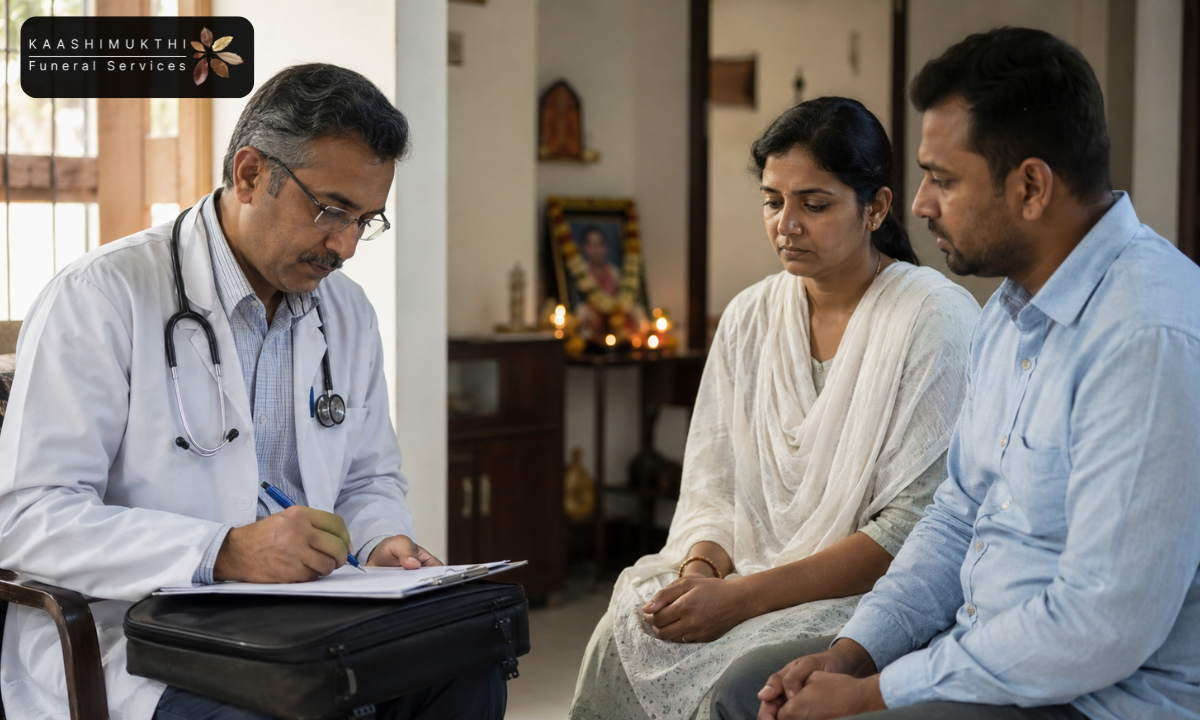
Losing a loved one at home is an experience marked by profound stillness and sudden, overwhelming responsibility. While your heart is focused on mourning, your mind is forced to navigate complex legalities.
Whether you are currently trying to arrange a dignified Hearse van service in Bangalore or seeking comprehensive funeral services in Bangalore, the very first hurdle is always administrative.
To begin any formal Funeral service in India, you must first secure a death certificate from a doctor. This document, legally known as the Medical Certificate of Cause of Death (MCCD), is the absolute cornerstone for all subsequent arrangements.
But where do you start when a passing occurs in a non-institutional setting? Do you know which specific medical professional has the legal authority to sign these forms? Are you aware of the critical differences between the various government forms required for home deaths versus hospital deaths? Perhaps most importantly, do you know how to ensure that the paperwork you receive will be accepted by municipal authorities without delay?
In this guide, we will walk you through the essential steps to obtain the MCCD at home. Our goal is to provide the clarity you need during this difficult time so that you can focus on what truly matters: paying a final, respectful tribute to your loved one.
Key Points at a Glance
- Defining the MCCD: Understanding why the medical certificate of cause of death is the mandatory starting point for all legal and funeral proceedings.
- Form 4 vs Form 4A: Identifying the crucial differences between these documents to ensure you have the correct paperwork for a death at home.
- The Doctor’s Role: Knowing which registered medical practitioners can legally certify a death and what they require from the family.
- Administrative Flow: A clear look at how a doctor’s certificate eventually leads to the final municipal death certificate.
- Professional Support: How a compassionate funeral service provider can manage these complex administrative tasks on your behalf.
What is the Medical Certificate of Cause of Death (MCCD)

When a family member passes away, the priority is naturally to honour their memory and perform the final rites.
However, from a legal and administrative perspective, the medical certificate of cause of death is the most significant document you will encounter in the immediate hours following the loss. Essentially, this is a formal statement issued by a Registered Medical Practitioner (RMP) that serves as the official medical record of why and how a person passed away.
The MCCD is not merely a piece of paper; it is a mandatory legal requirement under the Registration of Births and Deaths Act, 1969.
Without this document, it is legally impossible to register the death with municipal authorities or to obtain the final death certificate required for settling estates, insurance claims, or bank accounts.
To understand its importance, it is helpful to look at the specific roles this certificate plays:
- Legal Validation of Natural Death: The primary purpose of a death certificate by a doctor is to confirm that the death occurred due to natural causes.
When a doctor examines the deceased at home, they are looking for clinical evidence of illness or age-related failure. This validation is what allows the family to proceed with funeral arrangements without the need for a police intervention or a forensic post-mortem.
- A Prerequisite for Final Rites: Most crematoriums and burial grounds in India, particularly in urban centres like Bangalore, will not accept a body for the final rites without an accompanying medical certificate.
It acts as the “clearance” that ensures the death has been medically noted and is not under any legal suspicion.
- Statistical Data for Public Health: On a broader scale, these certificates are used by the government and health organisations to track mortality rates and the prevalence of specific diseases. This data is vital for planning public health policies and medical research across the country.
It is important to remember that the MCCD is a confidential medical document and consists of two parts: a formal certificate given to the family to register the death, and a statistical portion that identifies the specific sequence of medical events leading to the passing.
The authority to issue this document lies solely with a doctor registered with the Medical Council. When you seek this certificate for a death at home, ensure the doctor provides the following details clearly:
- The full name and age of the deceased.
- The exact date and time of the passing.
- The immediate cause of death (e.g., cardiac arrest).
- The underlying cause of death (e.g., long-term chronic kidney disease).
- The doctor’s own registration number and official seal.
After securing a comprehensive MCCD, you establish a solid legal foundation for all the steps that follow, ensuring that your loved one’s transition is handled with the dignity and legal correctness it deserves.
Understanding the Paperwork of Form 4 vs Form 4A

Navigating the various administrative forms issued by the government can be a daunting task, particularly when you are in the midst of grieving. When it comes to the medical certificate of cause of death, there is often significant confusion regarding which specific document is required. In India, the Registration of Births and Deaths Act categorises deaths based on where they occur, and this distinction dictates whether a doctor will issue a Form 4 or a Form 4A death certificate.
Understanding these differences is crucial because submitting the wrong form to your local municipal office can lead to significant delays in receiving the final death certificate. Here is a comprehensive breakdown of the two primary forms used in this process:
Form 4: The Institutional Medical Certificate
The Form 4 death certificate is specifically designed for deaths that occur within a medical institution. This is the standard document issued when a patient passes away while admitted to a hospital, a nursing home, or a specialised clinic.
- Issuing Authority: This form is completed by the medical officer or the attending doctor who was treating the patient within the facility.
- Data Specifics: Because the patient was under hospital care, this form often contains detailed clinical data regarding the duration of the illness and the specific medical interventions that took place before the passing.
- Direct Registration: Usually, hospitals have a direct administrative link to the municipal corporation, meaning they may handle the initial digital upload of this form into the Civil Registration System (CRS) on behalf of the family.
Form 4A: The Non-Institutional Medical Certificate
For this guide, the Form 4a death certificate is the most relevant document. This version of the MCCD is specifically reserved for non-institutional deaths, which include any passing that occurs at home, in a private residence, or in a public space outside of a hospital.
- The Necessity for Home Deaths: If your loved one passes away at home, you must ensure the visiting doctor completes Form 4A. A standard Form 4 will not be accepted by the municipal registrar for a death that occurred in a private residence.
- The Role of the Private Doctor: Since the individual was not under the direct supervision of a hospital staff at the time of death, a Registered Medical Practitioner (RMP) must visit the home to verify the passing. They will use Form 4A to certify that, based on the medical history and physical examination, the death was natural.
- Information Required: Just like the institutional version, Form 4A requires the doctor to clearly state the immediate cause of death and any underlying conditions. However, it is specifically formatted to acknowledge that the death took place in a non-medical environment.
Why the Distinction Matters for Families
Families need to recognise that these forms serve as the primary evidence for the local registrar. If a doctor mistakenly uses a hospital-focused MCCD Form 4 for a death that happened at home, the municipal authorities will likely flag the discrepancy.
To ensure a seamless process, we recommend checking the heading of the document before the doctor leaves your home. It should explicitly state “Form 4A” and “Medical Certificate of Cause of Death (For non-institutional deaths).”
Taking this small, proactive step ensures that the legal record of your loved one’s passing is accurate and compliant with national regulations, saving you from unnecessary administrative hurdles during an already stressful time.
Step-by-Step Guide for Securing a Death Certificate by a Doctor at Home

When a passing occurs within the sanctity of the home, the immediate responsibility of securing a medical certificate of cause of death can feel like a daunting task.
However, the process is structured to be straightforward if you follow the correct sequence of actions. This step-by-step guide is designed to help you navigate these initial hours with confidence, ensuring that you obtain a valid death certificate from a doctor without unnecessary delays.
Step 1: Contact a Registered Medical Practitioner
The very first step is to contact a doctor who is registered with the Medical Council of India. If the deceased had a long-term family doctor or a general practitioner who was treating them for chronic conditions, they are the most appropriate person to call.
As they are familiar with the patient’s medical history, they can quickly verify if the death was a natural progression of an existing illness. If a family doctor is unavailable, any local Registered Medical Practitioner (RMP) can be requested to visit the home to certify the death.
Step 2: Gather Past Medical Records and Identification
Before the doctor arrives, it is vital to have all relevant documentation organised and ready for review. This preparation is essential for the doctor to confidently state the cause of death. You should have the following items nearby:
- The deceased’s government-issued identification, such as an Aadhar card or passport.
- Recent hospital discharge summaries or clinical notes.
- Prescriptions and a list of medications the individual was currently taking.
Any recent diagnostic reports, such as ECGs or blood tests, that highlight underlying health conditions also play a vital role.
Step 3: The Medical Examination at Home
Once the doctor arrives, they will perform a physical examination to confirm the passing and rule out any suspicious circumstances. They will check for the absence of a pulse and breathing, and observe for clinical signs that verify the time of death. The doctor will also review the medical records you have provided to correlate the physical findings with the person’s health history. If the doctor is satisfied that the death occurred due to natural causes, they will proceed with the paperwork.
Step 4: Completion of the Form 4A Death Certificate
As discussed previously, for a death occurring at home, the doctor must specifically use the Form 4a death certificate. During this step, it is helpful to ensure the following details are recorded accurately:
- The Cause of Death: The doctor will distinguish between the immediate cause (the final event, like cardiac arrest) and the antecedent cause (the long-term illness, like diabetes or hypertension).
- The Duration of Illness: This section records how long the deceased suffered from the underlying condition, which provides critical context for the municipal registrar.
Step 5: Verifying the Official Seal and Registration Number, a medical certificate of the cause of death
It is only legally valid if it carries the clear authority of the signing physician. Before the doctor leaves your residence, please ensure that the certificate includes their full name, their official medical registration number, and their clinic or hospital seal. A certificate without a visible registration number or seal will likely be rejected by the crematorium or the local ward office, causing significant distress during the final rites.
Step 6: Making Copies for Immediate Use
Once you have the signed Form 4A in hand, we strongly recommend taking several clear photographs or photocopies of the document. You will need to submit the original to the crematorium or the registrar, but having copies is essential for your own records and for coordinating other arrangements, such as a hearse or funeral service.
By following this professional protocol, you ensure that the administrative transition is handled with the same level of respect and care that you are providing to your loved one.
Crucial Documents You Must Keep Handy
When a doctor arrives at your residence to issue a medical certificate of cause of death, their primary responsibility is to verify that the passing was natural and consistent with the individual’s health history.
To make this process as efficient as possible during an emotional time, having a dedicated folder of documents ready is essential. Being organised allows the medical practitioner to complete the paperwork accurately, ensuring your death certificate from a doctor is legally robust.
Here is a comprehensive checklist of the documents and information you should keep ready for the doctor’s review:
1. Identification of the deceased
The doctor must ensure that the personal details on the medical certificate exactly match official government records. Discrepancies in the spelling of a name or age can cause significant issues when you later apply for the final municipal certificate.
- Original Aadhar Card: This is the most vital document for identification in India.
- Alternative ID: If Aadhar is unavailable, a Voter ID, Passport, or Senior Citizen Card should be provided.
- Proof of Age: Documents that clearly state the date of birth if it is not listed on the primary ID.
2. Comprehensive Medical History
If the individual was suffering from a chronic illness, the doctor needs to see the clinical evidence of that condition to rule out any suspicious circumstances.
- Recent Hospital Discharge Summaries: If the loved one was recently hospitalised, these summaries provide the most credible evidence of their medical status.
- Latest Prescriptions: Showing the current medications being taken helps the doctor understand the underlying health conditions, such as heart disease, hypertension, or diabetes.
- Doctor’s Consultation Notes: Any recent notes from a primary care physician or a specialist (like a cardiologist or oncologist) are extremely helpful.
3. Recent Diagnostic and Lab Reports
Sometimes, a physical examination and a prescription list are not enough to provide a specific cause of death. Scientific reports provide the objective data the doctor needs.
- Latest ECG or Echo Reports: Essential if the suspected cause is cardiac-related.
- Recent Blood Work: Reports from the last few months that show kidney function, glucose levels, or other vital markers.
- Imaging Reports: Any recent X-rays, CT scans, or MRI reports that highlight serious health issues.
4. Contact Details of the Primary Treating Physician
If the visiting doctor has any specific questions about the patient’s long-term treatment, they may wish to speak briefly with the doctor who was managing the case.
- Name and Phone Number: Keep the contact details of the family doctor or the specialist who was most involved in the patient’s care.
- Hospital or Clinic Name: Knowing where the patient was primarily treated allows the visiting doctor to verify the clinical history if necessary.
Having these materials prepared, you assist the medical professional in providing a thorough and accurate medical certificate of cause of death.
This preparation not only speeds up the immediate process but also provides you with the peace of mind that the legal transition of your loved one is being handled with the highest level of professional care.
Transitioning from the MCCD to the Final Municipal Certificate
Securing the Form 4A from a visiting doctor is a critical achievement, but it is only the first half of the administrative process.
Many families mistakenly believe that the doctor’s document is the ultimate legal proof of death. However, there is a distinct difference between the medical documentation (the MCCD) and the final legal documentation.
The MCCD simply allows you to proceed with the final rites; it is the municipal authority that issues the legally binding death certificate required for settling bank accounts, claiming insurance, and transferring property.
To ensure your family is fully protected legally, you must transition the medical certificate into a municipal registration. Here is exactly how that process unfolds:
1. The Role of the Crematorium or Burial Ground
When you arrive at the crematorium or burial site, the authorities there will demand to see the original medical certificate of the cause of death.
They will retain a copy of this form and, upon completion of the final rites, they will issue you a cremation or burial receipt. This receipt is a vital piece of evidence proving that the final disposition of the body has legally taken place.
2. The 21 Day Registration Window
Under the Registration of Births and Deaths Act of 1969, every death in India must be registered with the local municipal registrar (such as the BBMP in Bangalore) within a strict timeframe of 21 days.
If you complete the registration within this window, the process is generally straightforward and free of penalty. If you miss this deadline, securing the certificate becomes significantly more complicated, requiring affidavits, late fees, and sometimes a magistrate’s order. We highly advise initiating this step within 24 to 48 hours.
3. Submission to the Local Authorities
To register the death, a family member or an authorised representative must submit the required documents to the local ward office or upload them via the state’s digital Civil Registration System (like the eJanMa portal in Karnataka). The required bundle typically includes:
- The original MCCD (Form 4A).
- The official cremation or burial receipt.
- The deceased’s Aadhar card or primary identification.
- The applicant’s identification and proof of relationship.
4. Receiving the Final Municipal Certificate
Once the local registrar verifies the medical and identification documents, they will officially record the event in the government database. Following this verification, the municipal corporation will issue the final, legally binding death certificate, complete with a government seal and a unique registration number.
We highly recommend requesting at least five to ten original copies of this final document. Almost every financial institution, insurance company, and legal entity will require an original copy, not just a photocopy, to process claims and close accounts.
Understanding this transition from medical to municipal certification, you can navigate the bureaucracy smoothly and secure your family’s legal standing without unnecessary distress.
Why Choose Kaashimukthi for Complete Assistance?
Navigating the immediate aftermath of a loss is incredibly overwhelming, especially when faced with the strict legal and administrative hurdles required by municipal authorities. At Kaashimukthi, we understand that a grieving family should not have to spend their most vulnerable hours searching for a registered medical practitioner, waiting in long queues at ward offices, or struggling to understand complex government forms.
As your dedicated funeral service provider, we offer comprehensive administrative support to completely remove this burden from your shoulders. When a passing occurs at home, families trust our expertise for several vital reasons:
1. Immediate Medical Coordination:
We assist in arranging prompt home visits by licensed, registered doctors to issue the correct Form 4A death certificate. We ensure the doctor is briefed on the necessary protocols, avoiding the common errors that lead to municipal rejections.
2. End-to-End Paperwork Management:
From the moment the medical certificate of cause of death is signed, our team takes over. We manage the submission to the local crematorium or burial ground and expertly navigate the local municipal systems (such as the BBMP in Bangalore) to secure your final, legal death certificates.
4. Handling Complex Scenarios:
If a situation requires a police No Objection Certificate (NOC) or if a hospital hesitates to provide paperwork, our experienced coordinators step in to liaise with authorities, ensuring the correct legal pathways are followed without causing distress to the family.
3. Seamless Funeral Logistics:
Beyond the paperwork, we provide complete, dignity-driven logistical support. Whether you require a specialized Hearse van service in Bangalore, a freezer box for preservation, or verified pandits for the final rites, we coordinate every detail meticulously.
Entrusting Kaashimukthi with these critical administrative tasks, you create a calm, undisturbed space for your family to mourn, reflect, and honour your loved one without the anxiety of legal complications.
The Way Forward
The moments following the loss of a family member are undeniably difficult. The sudden shift from providing care to managing legalities can feel incredibly jarring. However, securing the right documentation, starting with the death certificate by a doctor, is the most profound way to protect your loved one’s legacy and ensure a smooth, dignified transition.
Understanding the difference between the hospital-issued Form 4 and the home-specific Form 4A is crucial. By preparing the necessary identification and medical history and by ensuring the visiting doctor correctly completes the MCCD, you establish the legal foundation required for all final rites and future administrative tasks. Remember, the medical certificate is just the first step; registering the death with the local municipality within the 21-day window is what ultimately secures your family’s legal standing.
You do not have to navigate this complex bureaucratic landscape alone. If you require immediate assistance securing medical certification, arranging transport, or planning a respectful farewell, Kaashimukthi is here to support you at every step. Reach out to our empathetic team today, and let us handle the administrative burdens so you can focus entirely on honouring the life of your loved one.
Frequently Asked Questions (FAQs)
1. Can any doctor issue a Form 4A for a death at home?
The certificate must be issued by a Registered Medical Practitioner (RMP) who is registered with the Medical Council of India. Ideally, this should be the family doctor who was treating the deceased for any underlying conditions, as they can most confidently verify that the passing was due to natural causes.
2. What happens if we do not get the death registered within 21 days?
Under Indian law, every death must be registered with the local municipal authority within 21 days. If you exceed this timeframe, the registration process becomes significantly more complex, often requiring the payment of late fees, submission of formal affidavits, and, in delayed cases, a direct order from a local magistrate. It is highly advisable to initiate the municipal registration immediately after the final rites.
3. Is a police NOC required if a loved one passes away peacefully at home?
If the death is clearly due to natural causes, old age, or a known chronic illness, and a registered doctor issues a valid Form 4A, police involvement is generally not required. However, if the passing is sudden, unexpected, or due to unnatural causes (such as an accident or suspected poisoning), the death becomes a medico-legal case, requiring police intimation and an NOC before cremation can occur.

Madhu is an Entrepreneur, a Mentor, a Writer and an Aspiring Car Race Driver. He is Deeply passionate about leveraging Technology and Human Centred Design to make complex care and End of Life Planning easier. With the ultimate aim of Improving the quality of Life in the Twilight years. Madhu is highly educated and Alumni of IIM-Bangalore, Sikkim Manipal University and Bangalore University besides a Rich Industry Experience in the field of Product Management, Design, Supply chain, Finance, Commercial Management and Funeral Services.